 EN
EN
- Overview
- Recommended Products
Ultrasonic dispersion
A significant application of ultrasonic dispersion is the dispersion and depolymerization of solids in liquids. Ultrasonic dispersion, which relies on the cavitation effect, is primarily employed to reduce particle size in liquids, thereby enhancing their uniformity and stability. It is also utilized for grinding and fine grinding of particles at micrometer and submicrometer scales.
Mechanisms of Ultrasonic Breakdown and Dispersion
Ultrasonic waves disrupt particle aggregates by inducing mechanical vibrations within the material, thereby generating effects such as shear forces, impact forces, and vortex flows. The specific mechanism is as follows:
1. Shear force effect: During ultrasonic propagation, relative displacement of molecules within a material induces shear forces. These shear forces can penetrate liquid layers and disperse particulate aggregates.
2. Impact force mechanism: During unidirectional propagation of ultrasound, high-density and low-density regions are formed along the sound wave direction. When particle aggregates exist in the liquid, they are impacted into the high-density region, thereby generating an impact force that can disrupt the particle aggregates.
3. Vortex flow effect: During the unidirectional propagation of ultrasound in a liquid, periodic compression and expansion processes are induced, resulting in vortex flow formation. Under the influence of this vortex flow, particle aggregates are subjected to local vibrations and shear forces, leading to their fragmentation.
Ultrasonic dispersion process
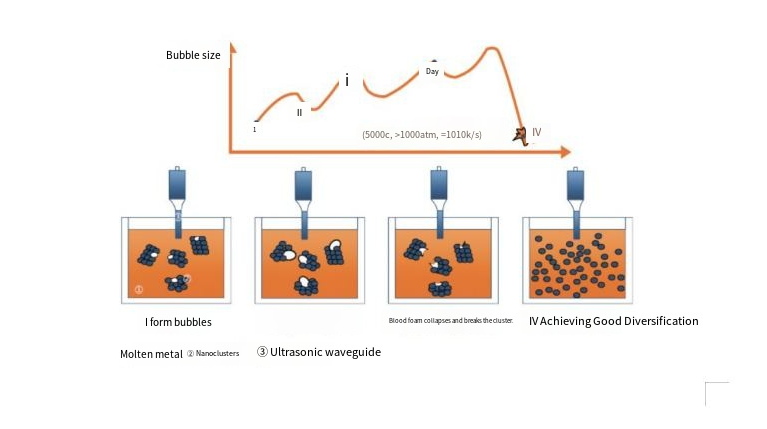
When ultrasound propagates through a liquid, it induces mechanical vibrations, shear forces, impact forces, and vortex flows in particle aggregates. These effects can disrupt and disperse the particle aggregates.
The main steps in the ultrasonic dispersion process are as follows:
1. Uniform mixing: First, the particle aggregates must be uniformly mixed with the liquid. This can be achieved by stirring or other methods.
2. Ultrasonic irradiation: Place the uniformly mixed liquid sample into an ultrasonic disperser, activate the generator to generate ultrasonic waves. The ultrasonic waves propagate unidirectionally and penetrate the liquid sample, inducing mechanical vibrations of particle aggregates as well as effects such as shear forces, impact forces, and vortex flows.
3. Breakdown and dispersion: Under ultrasonic irradiation, particle aggregates are broken down and dispersed, resulting in uniform distribution throughout the liquid. The extent of breakdown and dispersion depends on factors such as ultrasonic frequency, power, exposure time, and sample properties.
4. Separation and Collection: Following ultrasonic irradiation, the particle aggregates have been effectively broken down and dispersed. Subsequently, the dispersed particles must be separated from the liquid using methods such as centrifugation or filtration. Finally, a uniformly distributed particle solution can be obtained.
Advantages and disadvantages of ultrasonic dispersion
The ultrasonic dispersion method offers the following advantages:
1. Simple operation: This method requires no complex equipment or specialized techniques, making it easy to perform;
2. Rapid preparation speed: Ultrasonic waves can rapidly disperse substances into solvents, resulting in swift preparation;
3. Broad applicability: The ultrasonic dispersion method is suitable for various types of substances, including inorganic compounds, organic compounds, and biomacromolecules.
However, this method also has the following drawbacks:
1. Energy density is difficult to control: Due to the challenges in precisely regulating ultrasonic energy density, it may lead to instability or loss of reactivity in certain reactions.
2. Side effects may occur during the reaction: The intense mechanical effects of ultrasound can adversely impact the reaction system under certain conditions;
3. specialized equipment is required: Although the method is straightforward to operate, it necessitates specific apparatus, resulting in higher costs.
Device Overview
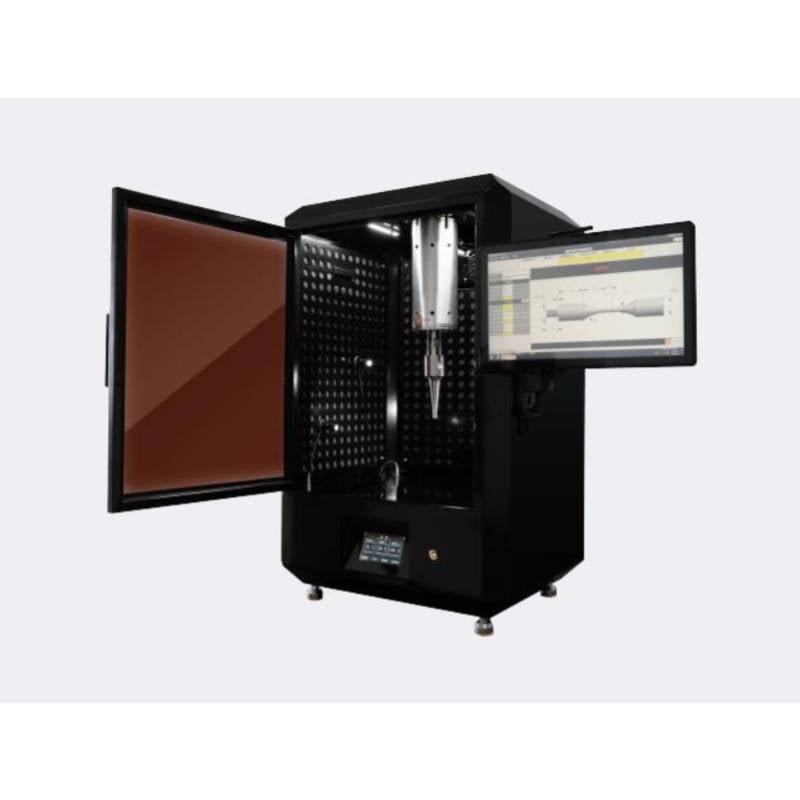
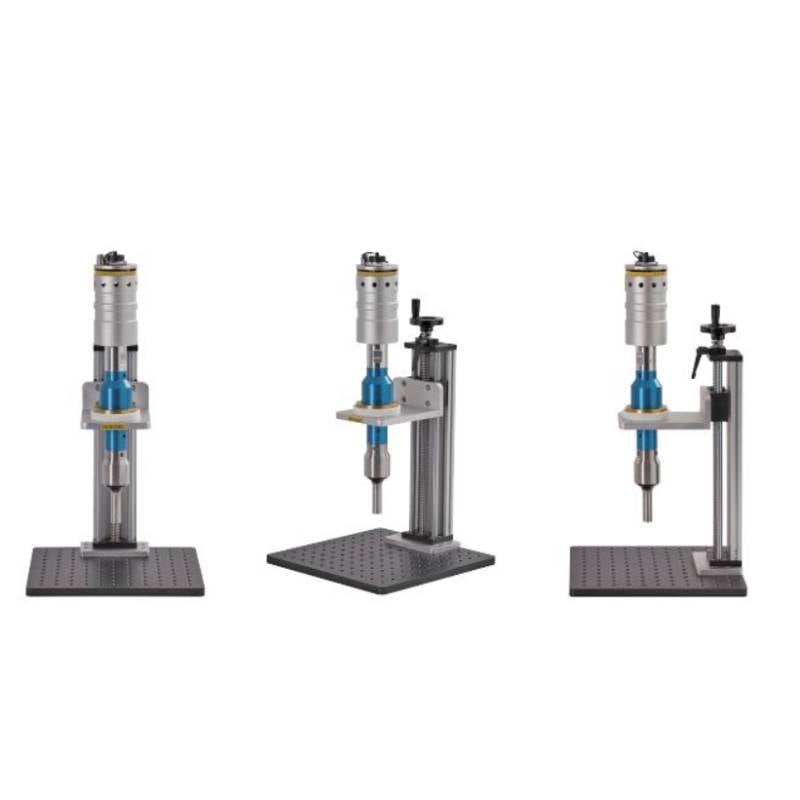
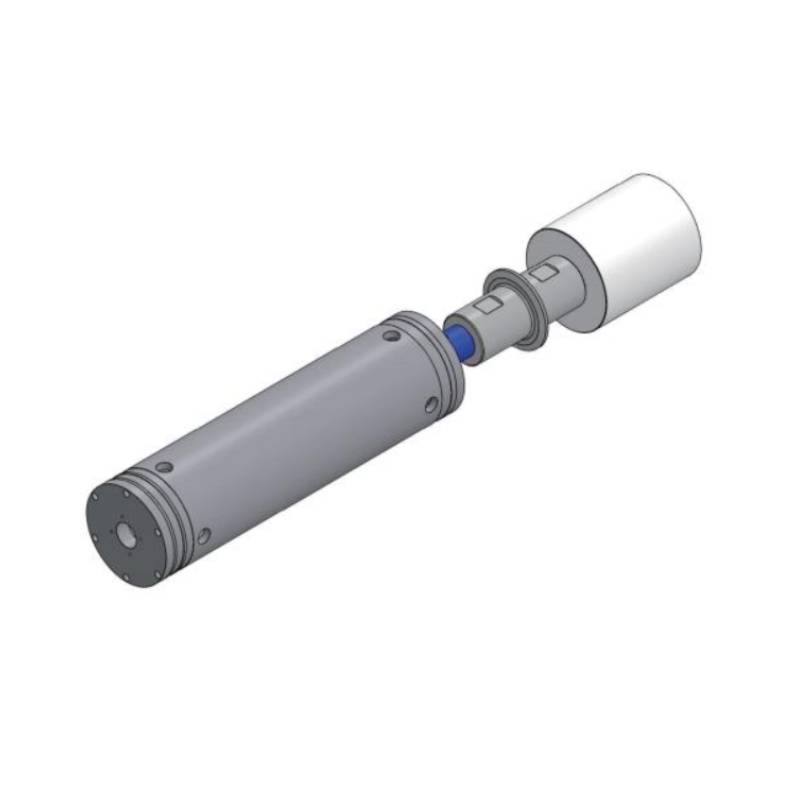
Ultrasonic disruption and dispersion of particle aggregates require specialized equipment—the ultrasonic disperser. The ultrasonic disperser consists of a generator, a transducer, and a reflector. The generator serves as the source of ultrasonic waves, converting electrical energy into mechanical vibration energy and transmitting it to the transducer; the transducer is the component that converts electrical energy into mechanical vibration energy, typically made of piezoelectric ceramic material which vibrates mechanically when subjected to an alternating voltage; the reflector directs the generated mechanical vibration energy back to the transducer, usually constructed from metal materials with excellent mechanical conductivity. During operation, the generator applies an alternating voltage to the transducer, causing it to vibrate under the electric field and transfer this vibration energy to the reflector, which then reflects the energy back to generate ultrasonic waves.
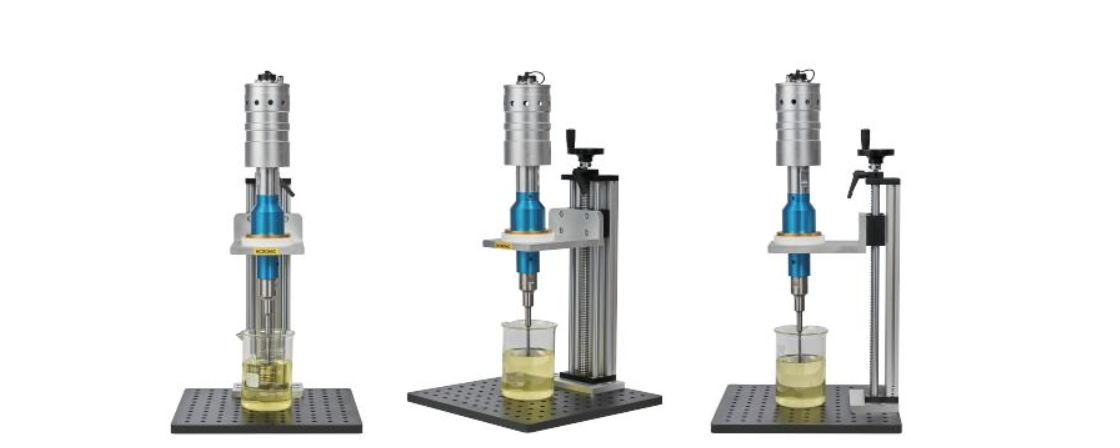
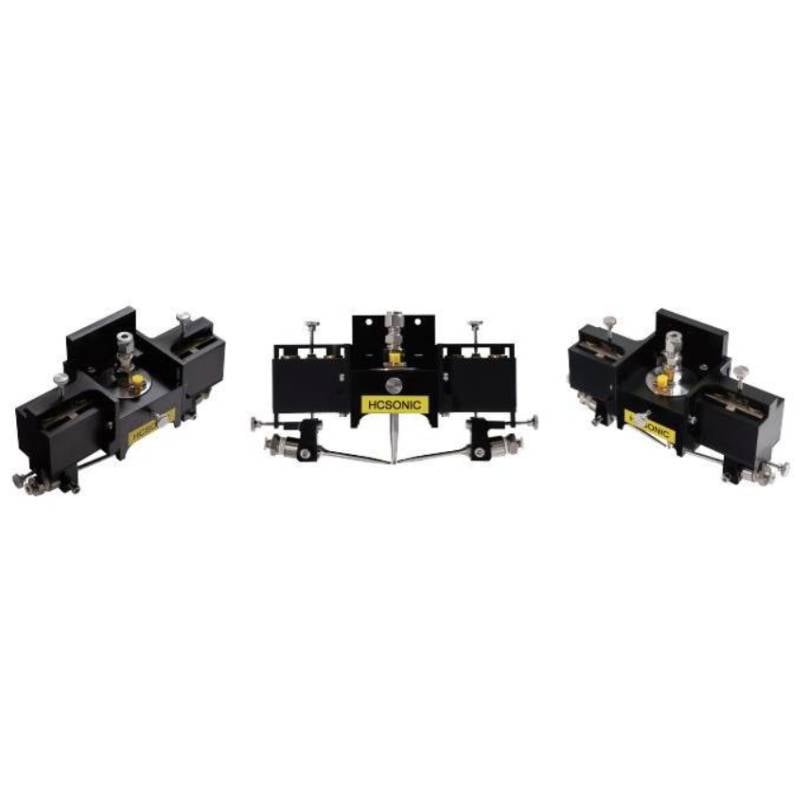
Viewed from different angles
Experimental Demonstration
Ultrasonic dispersion is a process that utilizes the mechanical vibration energy of ultrasound to break down and disperse particle aggregates. Through effects such as shear force, impact force, and vortex flow, ultrasound can effectively fragment and disperse particle aggregates, ensuring their uniform distribution in liquids. This technology holds broad application prospects in industries including chemical engineering, pharmaceuticals, and food processing. By appropriately selecting parameters such as ultrasound frequency, power, and exposure time, effective fragmentation and dispersion of particle aggregates can be achieved.
Plant parameter
| Total Technical Parameters | Vibration Component Parameters | Assemble Component Parameters |
| Specification Model: HC-LP2005GL-3 | Cooling method: Air cooling | Transducer: Piezoelectric ceramic/imported aluminum |
| Device Power: 300W/500W | Maximum service temperature: 0–45°C | Amplitude rod: High-quality aviation-grade aluminum |
| Operating frequency: 20.0 ± 1 kHz | Maximum allowable pressure: atmospheric pressure | Tool head: High-strength titanium alloy |
| Input Voltage: 220V/50Hz | Vibration component power: 1000W | Fixed flange: High-strength aluminum alloy |
Applications of Ultrasonic Dispersion:
Ultrasonic dispersion technology finds extensive applications in numerous fields, including: -Chemical industry: for preparing emulsions and latexes of nanomaterials. -Pharmaceutical industry: for developing nano-drug carriers and microsphere dosage forms. -Food industry: for producing emulsifiers, stabilizers, and additives. -Environmental protection: for treating suspended solids and precipitates in wastewater.
The ultrasonic dispersion method has found extensive applications in pharmaceutical formulations, biomedical research, and materials science. For instance, in pharmaceutical development, it enables the preparation of nanoparticle drugs to enhance their efficacy and bioavailability; in biomedicine, it facilitates the fabrication of nanoparticle probes and carriers, playing a crucial role in tumor therapy and diagnosis; in materials science, it facilitates the synthesis of nanomaterials for high-performance electronic devices and sensors.
Applications of sonochemical equipment
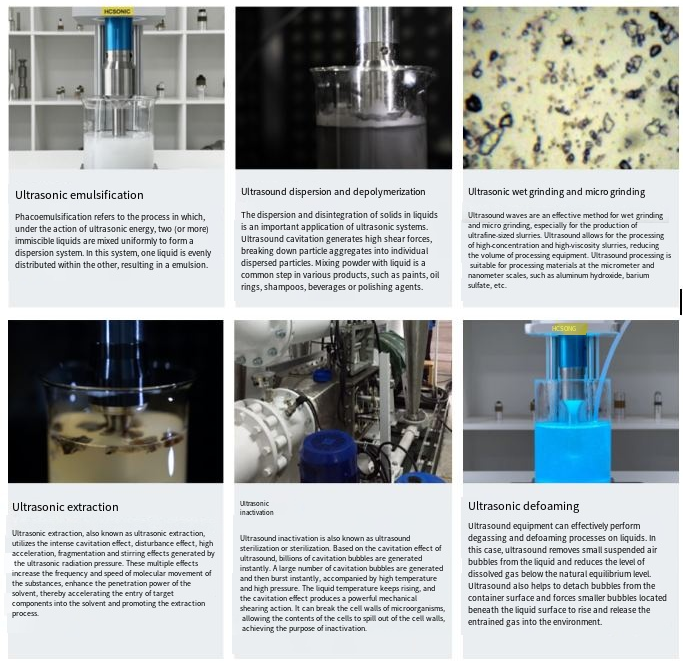
Ultrasonic emulsification equipment is widely used in industrial sectors such as food, papermaking, coatings, chemicals, pharmaceuticals, textiles, petroleum, and metallurgy. It can be easily integrated into existing production lines, enabling manufacturers to upgrade their equipment at low cost. Ultrasonic emulsification also enables the preparation of emulsions that cannot be achieved by conventional methods. While conventional mixing techniques can only produce 5% wax emulsions in water, it is remarkable that under ultrasonic power, 20% wax emulsions can be manufactured.
Common Questions Guide
1. What to do if the temperature is excessively high during liquid processing? ① Use pulse mode. ② Use ice cooling combined with pulse mode. ③ The cooler provides additional cooling capacity. ④ Use a tool head resistant to high temperatures during processing.
2. How to cool the transducer? Prolonged ultrasonic treatment can cause heat to transfer from the probe head to the transducer. Overheating may severely damage the transducer and the entire ultrasonic system. For larger samples requiring continuous processing for more than 30 minutes, it is recommended to install an air cooling device for the transducer.
3. How to select the appropriate container? Container shape and size: Narrow containers are preferable to wide ones, as ultrasonic energy is generated at the end surface and transmitted downward. During sample processing, the liquid is pushed downward and dispersed in all directions. If the container is too wide, effective mixing cannot be achieved, and some samples may remain untreated around the edges. For a given volume, processing time is shorter in wider containers compared to narrow containers (approximately twice as long). Additionally, the probe must not contact the container's sides or bottom. End surface diameter: -1/4 inch (6 mm): Processing range: 10 mL – 50 mL -1/2 inch (12 mm): Processing range: 20 mL – 250 mL -3/4 inch (19 mm): Processing range: 50 mL – 500 mL -1 inch (25 mm): Processing range: 100 mL – 1000 mL Each tool head has a recommended sample volume range; using the appropriate tool head size is crucial not only for reducing processing time but also for extending its service life. The use of a stirring rod can further increase the maximum processing capacity of the probe.
4. What is the minimum droplet size achievable with ultrasonic processing? Ultrasonic processors can be utilized to produce stable, high-quality nanoemulsions, including semi-transparent nanoemulsions with droplet sizes below 100 nm.
5. Is using a constant power of 70% for sample processing appropriate? You should test other power levels and evaluate their impact on results. If identical results are achieved at 50%, there is no need to use 70%. However, it is recommended to maintain power below 80% to extend probe lifespan.
6. Immersion depth of the vibrating component and bubble formation issues.
The tip of the tool must be properly submerged; if the tip is not fully submerged, the sample may foam or develop bubbles. If the tip is too deep, effective sample circulation cannot occur. Both scenarios will lead to poor results. Foaming frequently occurs when the sample volume is below 1 mL and can also be induced by setting an excessively high amplitude.
7. How to address cavitation on the tip surface of liquid handling tool heads? The equipment is equipped with replaceable tip tool heads (replacement caps), which feature rigid threads at their ends for connection to the tool head. When the replacement cap wears out due to cavitation, it can be removed and replaced.
8. Is ultrasound harmful to humans? What are the safety precautions? Noise is the only known concern. To reduce the noise level of an ultrasonic processor to an acceptable level, it should be minimized to approximately 25 BA. The simplest solution is to wear professional noise-canceling earplugs; they are inexpensive and widely available, though their use may be inconvenient in many public settings. Another option is to house the ultrasonic processor within a noise-reducing enclosure (silencer or soundproof housing). For laboratory-grade equipment, such enclosures are readily available but must provide adequate noise reduction performance.